Thursday, April 4, 2013

RE: Radiohead's "Pyramid Song": Ambiguity, Rhythm, and Participation


Music notation is descriptive. There is no single absolutely correct way of transcribing any piece of music any more than there is a single absolutely correct way to express particular fractions. 1/2 is 2/4 is 4/8 is 8/16. Not a single one of these is incorrect.

However, it behooves us to transcribe music in such a manner that it is readily understandable and indicates the correct feel of the music. A person reading and playing from the score, assuming they are reasonably capable on their instrument, should be able to reproduce the music accurately. With respect to this particular goal, certain ways of transcribing a piece of music are obviously better than certain others.

There have been inordinate measures of discussion concerning Radiohead's "Pyramid Song" from their album Amnesiac. It's an excellent song, definitely worthy of analysis, and given that the rhythm is relatively unusual for a piece of music written by a rock group, the amount of discussion is perhaps understandable. In fact, for as long as I've been aware of Radiohead, my opinion has been that, in spite of all the talk of their purported innovation and weirdness, the best things they have going for them are: first and most importantly, a firm sense of effective melodic and harmonic content; and secondly and slightly less importantly, a special talent for arrangement and production that lends their work a certain uniqueness and importance within the music world. They matter in a musico-historical sense, but not because they are weird or innovative (they aren't especially weird or innovative, in fact). They matter because of compositional prowess.

Having said that, "Pyramid Song" is a special example of a piece of music that uses nonstandard rhythms in an effective way that benefits the music significantly, rather than using them for the sake of being unusual. Melodically and harmonically, it is very well written. Rhythmically, it is also very well written, and unusual rhythms are definitely my compositional specialty. So to me, it is not surprising that it has generated so much discussion so consistently. The discussion apparently goes on even today.

In the March 2013 issue of Music Theory Online, Nathan D. Hesselink offers his thorough take on the song, compiling a comprehensive list of analyses of the song's rhythm. Unfortunately, the simplest and clearest interpretation in my estimation receives relatively little coverage. Two of the comments made under the mixed meter subheading hit the mark exactly, but none of the example images highlight these, though some are close.

In my opinion, the best way to write it is as follows:

Consistent cycles of 3/4, 2/4, and 3/4 throughout the entire song. The lengths of the five chords in each cycle are two dotted quarters, a half, followed by two more dotted quarters. It is swung, so that odd numbered eighth notes are twice as long as even numbered eighths, as though we were dealing with triplets. Thus, in terms of the feel of the music, the 3/4 bars have 9 atomic note lengths, while the 2/4 bars have 6. What I mean is that if you divide the 3/4 bars into 9 equal pieces and the 2/4 bars into 6 equal pieces, this is sufficient to depict every note in exact detail. The first chord is 5 atoms long, the second is 4, the third is 6, the fourth is 5, and the fifth is 4.

Thus, you could theoretically describe the music as cycles of 9/8, 6/8, and 9/8 as some have suggested. However, this requires tying notes together just about everywhere and needlessly complicating the score. It is far simpler to use 3/4, 2/4, and 3/4 and then plainly indicate the feel of the swing at the top of the score. This requires absolutely no ties, and correctly indicates what's going on.

Compare and decide for yourself. This...


...is technically equivalent to this...


Which do you prefer?

Friday, March 22, 2013

What Happens When You Complete "A Man and His Droid"

My dreams last night were weird. It's kind of a jumbly haze now, or perhaps a hazy jumble, but the main thing is that it's hard to express clearly what happened.

I think I was driving in a car with Randall Munroe and we were trying to get to the top of an extremely tall parking structure. For some reason, it was necessary to collect a variety of different species of octopuses on the way, and in fact, I think collecting these cephalopods and organizing them in some important fashion was somehow the means by which we were travelling up the structure. Frustratingly, they were bigger than regular octopuses, and they were angry and mean and hostile to us and kept trying to attack our vehicle. And to make matters worse, Randall and I couldn't agree on the order in which the many monstrous mollusks should be gathered. It was a losing arrangement from the get-go.

And then at some point I think we gathered enough of the eight-leggers to be awarded a private concert given by Robert Fripp. Unexpectedly, he was a stop-motion animated clay Fripp. And he had five torsos. And rainbow colored hair. And his hair was in the form of large bundles of wheat.

So that was fairly normal, but otherwise, I seem to recall that my dreams were weird last night. I just can't really remember any of the weird parts.

Saturday, March 16, 2013

7DRL Challenge 2013: Uushuvud (End of Day Five)


A rough Windows only version of Uushuvud is complete. You can download it here. I hope, I hope, I hope that it will run on your machine.

Glory!
In Uushuvud, you have mysteriously been transported into another world called Uushuvud, where your head has mysteriously been transformed into an '@' symbol. You must attempt to survive long enough to find out what's going on and how you might be able to get your head back to normal and get home.

Controls:

Keypad/Arrow Keys: Move or attack adjacent enemies
P: Pick up items
R: Read books
H: Use health potion (restores 20 HP)
T: Use teleport potion (randomly teleports you somewhere within a ~60 cell x ~60 cell square area around your current location)
E: Use explode potion (hits all enemies within 5 cells of your location with fire)
X: End level (only valid in "end-of-level" temple (a big room with a small room inside with a lighter floor color))

Q: Quit (no confirmation dialog at all; this will immediately close the program)

Known issues:

  • Swords appear as black squares. I haven't been able to figure out why.
  • When you die, the program instantly closes. There is no "You died! Sorry!" screen or anything.
  • The enemies get stuck on rocks and walls easily.
  • The game is a little hard. This is a feature, not a bug. It's a roguelike.
  • "Tablespoons" is misspelled in the partial apple pie recipe. You might say this is an issue so minor that a point on a "known issues" list isn't warranted, but think again! The pies come out tasting weird. Does this sound unimportant to you?
Tips:
  • Don't accidentally press 'Q'. You will lose your progress.
  • Pick up every potion in a level before travelling to the next one. This is especially true on early levels where the situation isn't very dangerous. You will need those potions later.
  • The number printed before weapons and armor is the level of the item, not a quantity. I know it looks weird, but whatever...
  • If you pick up a weapon or armor, you will discard your current weapon or armor. It is gone forever, so don't pick up equipment that's worse than what you already have.
  • Try to avoid using explode potions on single enemies. The ability to attack multiple nearby enemies at once is valuable. Try to lure them together.
  • The enemies get stuck on rocks and walls easily. You can use this fact to help you escape when running low on HP and potions.
  • Beware of Gaums.
  • Spears and axes are generally the best weapons, followed by swords and maces, then clubs, and finally daggers. However, when choosing which weapon to use, also consider the weapon's level. A 12 Dagger is better than a 1 Spear.
  • Armor from worst to best: Leather, Iron, Steel, Tempered Steel, Perfect Steel
  • Seriously, beware of Gaums. They are mean.
  • When you level up, your HP increases and is restored to its maximum. Watch your EXP and consider whether health potions might be saved until after you level up.
  • For that matter, keep an eye on your HP at all times.
  • Have I mentioned to beware of Gaums?
  • Good luck!


Friday, March 15, 2013

7DRL Challenge 2013: Uushuvud (Halfway through Day Five)


Things are coming together. Still not quite there yet, but it's looking good!

I'm going to be out of town for the weekend, so today is the last day that I can really work on this. That means if I succeed, this will be a 5DRL! If not, then oh well.

I think I can manage it!!!

Thursday, March 14, 2013

7DRL Challenge 2013: Uushuvud (Day Four)


There's actually not a lot left to do. Running into bugs now though, so I'm going to keep this entry very short.

7DRL Challenge 2013: Uushuvud (Day Three)

No screenshot today, but there will be probably be one tomorrow. You'll have to be patient. :P

My efforts for day three progressed smoothly. I spent a little time tweaking the level generation, but I kept this to a minimum and focused this time only on fixing real problems with it. Aside from that, I got my item and creature data into a much better state than it was in at the end of day two.

If I release the source code at the end of all this, then some might notice that I am hard coding all my data into tables compiled directly into the program and wonder why I'm doing this. The answer is twofold.

First, I'm used to programming for embedded systems with no file I/O at all.

Second, I'm trying to manage my time wisely. For this project, this means not mucking around with file I/O routines. It's a small game. There's no real need to have my data stored in external files. And there's not going to be any save/restore feature. You have to get through the game in a single go. So there's no file I/O, and I can spend my time working on other stuff.

Last time I tried a 7DRL, I got so carried away with level generation that I think I spent three or four days just on that. There wasn't enough time for everything else, and the game slipped past the seven day mark, and then the fourteen day mark, and now it's more like seven months.

I guess level generation is kind of my thing. I've already spent more time on it for Uushuvud than I had originally intended, but I just really wanted it to be good, even though it's a 7DRL project. That means, first and foremost: No unreachable areas.

My algorithm right now could theoretically produce unreachable areas, but I'm pretty sure it's about 1:10000 for that to happen, and probably like 1:80000 for an unreachable area with important stuff in it (the exit, the player's starting point, etc.). If I make another small change I'm planning that'll take me four seconds, it'll be more like 1:204800000, not really a concern. I'm tempted to write a quick check function that verifies a level has no unreachable areas before showing it to the player, but I really just want to get on with other stuff. Maybe if there's time at the end of development...

Wednesday, March 13, 2013

7DRL Challenge 2013: Uushuvud (Day Two)


Everything is white right now, but it will soon be in multiple colors. I spent my first two days mostly developing the level generation for Uushuvud. It is now working to an extent that I consider acceptable. Aside from that, I spent a great deal of time working on the history of the game world and the relatively simple plot that will be present in the game. These are basically finished now. I can focus completely on programming at this point.

I have the beginnings of a data organization scheme for items and creatures, and I think my efforts for today will be focused on fleshing these out and possibly integrating them with the level data, getting items and monsters placed in the game world. If I have time, I'll try to get some basic monster and player movement in place, but we'll see how that goes.

Definitely on track to have this finished by Sunday!

Tuesday, March 12, 2013

7DRL Challenge 2013: Uushuvud

I hereby declare that I am entering 7DRL Challenge 2013!! My game will be called Uushuvud.

Screenshot to come. PREPARE YOURSELF.

Wednesday, January 16, 2013

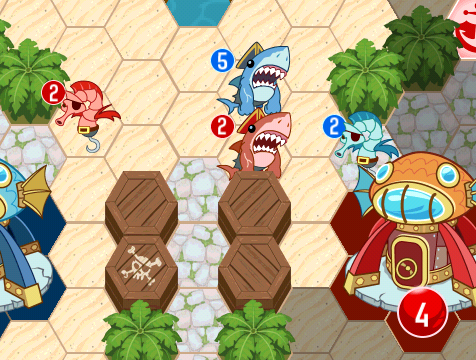
Outwitters: No Spawns! (Part One)


In my previous entry, I mentioned a game called Outwitters. I started playing this game several months ago, and it instantly became my new favorite game. In the time since then, however, it has nevertheless become even more and more interesting and enjoyable to me. I would recommend it to anyone who enjoys turn based strategy games, on the condition that they don't mind waiting for opponents to take their turns, an unavoidable necessity of asynchronous online games. It is available on iPhone, iPad, and iPod Touch and is free to download, though I highly recommend purchasing the Uber Pack to gain all the additional teams aside from the bundled one (there are four total).


I recently participated in a fan organized tournament in which we imposed the restriction that we could not spawn any units. We had to use only the units we were given at the start of the game. One consequence of this was that managing wits was less important. Since there were no spawns allowed, once a unit was captured, it was gone forever. There was no replacing it. This style of play demands extremely cautious and defensive strategies, which means that attacks were rare, and we focused on moving our units around and buffing them with the medic. Eventually, we had more wits than we could reasonably spend in a single turn. Soon enough, I completely stopped thinking about how many wits I had and assumed I could move and attack (or heal) with each and every one of my five units if I wanted to. At the beginning of these games, this might not have been quite true, but by turn 4 or 5, wits were no longer really much of an issue.


I had the thought to write up a detailed analysis of my experiences, but in planning to do so, I realized that if I went as in-depth as I really wanted to, then there would be more of interest in these ten short games than I could reasonably cover in a short amount of time. Therefore, I decided it might be better to do a short series of writeups, providing in-depth commentary on a few select moments that I found particularly interesting.


To start off, here's a really critical moment from one of my last games as P2. It's from the endgame, the last few exchanges between my opponent and myself. I was in the process of sneaking my soldier along the bottom of the map towards my opponent's base when units up north started capturing each other. If I'd gotten my soldier on his way a turn sooner, things would have been much simpler, but as it happened the timing made this a very tense move for me.


P1: harvarnold
P2: TheGreatErenan
Map: Long Nine 


Here are the links to the replay of the entire game:


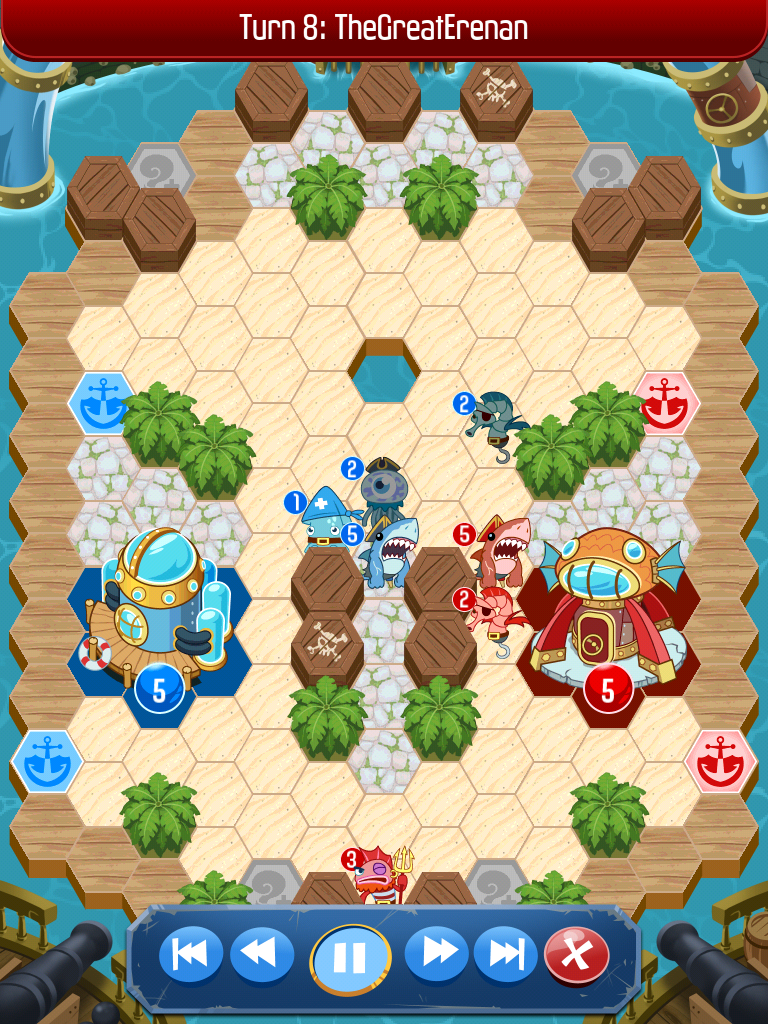
We'll pick it up in Turn 8, probably the most precarious moment of the game on my end.


This is a really critical move. At this point, I'm aware of the locations of all my opponent's units (I'd already captured his soldier on an earlier turn), though he can't know exactly where my soldier is. Anyway, I have some choices to make. Let's start with the easy decisions: It seems clear that I need to capture the sniper with my heavy or else my opponent would overwhelm me easily on the next turn. I don't have the firepower to take out the heavy, so it has to be the sniper. In addition, it's equally clear that I should then capture the medic with my runner, since if I attack either the runner or the heavy, the medic would simply heal it on the next turn, and I would have wasted my runner's attack power.


So I move my heavy to the space southeast of the sniper and make the capture. I also move my runner northwest of the medic and capture it. The placement of these two units is important.


The placement of both units should be fairly obvious to seasoned Outwitters players, but I'll explain anyhow. By putting the runner northwest of the medic, then if my opponent should decide to capture my runner with his heavy, then he would have to move it away from my base, which is a good thing for me because I am trying to delay my opponent's attack on my base as long as possible.


As for my heavy, under very different circumstances I might have placed the heavy northeast of the sniper instead of southeast, so as to force the enemy heavy to move before attacking mine and therefore having to spend that extra wit doing so. Additionally, that way my opponent would not have had the option of first attacking and then moving the heavy somewhere else. However, in this scenario it's clear that my primary goal is to prevent my opponent from destroying my base. Placing the heavy where I did prevents my opponent from moving the heavy next to my base, thus gaining me an extra turn.


Now for the tricky part.


My soldier at the bottom of the map is a tough call. Do I advance or do I retreat? I have to calculate very carefully here. Do I have enough turns to spare to destroy the enemy base with that soldier? Or do I need to move the soldier backwards to help defend the base?

I first consider what would happen if I advance the soldier. 


First of all, I can tell immediately that my opponent needs at least two turns to destroy my base. With only a runner and a heavy, only four points of damage can be inflicted in a single turn, but since my base still has five points, one turn won't be enough.


Unfortunately, with only my soldier guaranteed an uninhibited attack on the base (and not until my next turn, at that), it isn't immediately clear if I'll have enough turns at my disposal. It depends upon whether I'll also have my runner available and what my opponent does with the heavy and runner menacing my base.


So I have to consider every sensible possibility for my opponent's next turn. Let's make some simple lists:


For the runner: 

1. Move and attack my runner

2. Move and attack my heavy

3. Move and attack my base


For the heavy: 

A. Attack my heavy (and move)

B. Move and capture my runner


Combining these lists, there are six options to consider. Let's start with the easy ones.

I can obviously disregard 1B, since it would be pure foolishness to attack my runner with his runner and then capture it with his heavy, since the heavy can capture it unassisted. The runner's attack would be wasted.


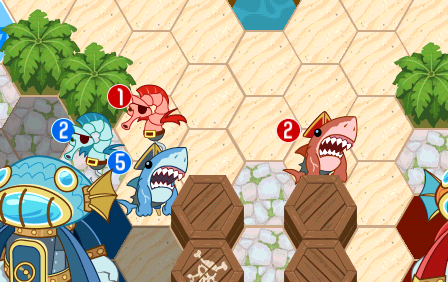
1A is also fairly simple to work out my response: My runner is buffed, so my opponent can't capture it with only a runner. Even if he tried to block my runner with his two units...


...this would put his heavy at least a full two turns away from my base. That means I can at least get his base down to one point before he gets his heavy to my base. Before that point, however, I could move my runner somewhere on the left edge of the map where I can hop down to hit his base, so that if my opponent doesn’t capture it, I’ll win on the next turn. If he does capture it, it’ll take him another two turns to get his runner back to my base, and in the meantime, I can slow his heavy down with my own heavy to give my soldier plenty of time to finish the base off. 1A is clearly a win for me.


Let's consider 2A:


If my opponent doesn't attack my base on this turn, then it's clear that he'll need two additional turns to destroy it. But this option allows me to attack the base with my runner, thus giving me the extra point of damage necessary to win within only one more of my turns. So 2A means a win for me, no matter where the opponent's runner and heavy are placed or what they do on the following turn. I could comfortably ignore the threat to my base and focus on attacking instead.


How about 2B:


This option basically leaves me with the choice of whether I should capture the runner or attack the heavy. Since my runner is gone, it'll take me at least two more turns to destroy the base with my soldier alone. My opponent isn't going to let my heavy near his base if he can help it, so if I advance and attack the heavy, then he'll capture it next turn with his runner and heavy. Of course, this will prevent him from attacking my base that turn, thus giving me the extra turn that I need to win. If I had captured the runner instead of attacking the heavy, it's even better, because then he won't be able to capture my heavy, thus allowing me to win easily on the following turn. 2B is a win for me.


That leaves 3A and 3B. These are a bit trickier, because the runner's attack brings my base down to four, putting it in danger of being destroyed next turn if the heavy gets a chance to touch it.


3B is perhaps the simpler of the two.


If no one has attacked my heavy, then it cannot be captured in the next turn, thus allowing me to move it west and on the next turn move it next to my opponent's base for the win. The heavy's capture of my runner means that it'll take two more turns to get it next to my base, giving me the time I need.


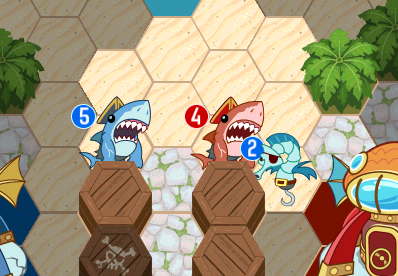
3A is probably the trickiest of all. If my opponent brings my base down to four points with the runner and keeps his heavy within range of my base, probably by going around the north end of my heavy...


...then ostensibly one more turn is all he needs to win. I need at least two. So I need to make sure he can't attack my base again with both heavy and runner. This can be done by blocking the heavy’s movement forward with my runner and heavy.


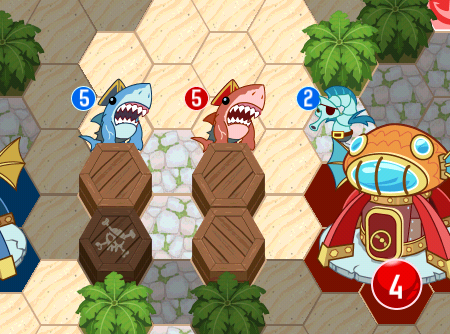
However, this alone isn't enough. I have to attack his heavy with both my heavy and my runner, bringing it down to one point.


This is critical. On his next turn he won't be able to capture both my runner and my heavy (his runner cannot capture either unit in this case, as they both have two points left). On my next turn, I'll be able to capture his heavy with whichever unit he doesn't capture, thus forcing him to use only his runner to attack my base, which obviously affords me the time I need to finish off his base.


So it seems that advancing my soldier is a good idea. My opponent ended up using option 1A, but it doesn't apppear that there was anything he could have done at this point to stop me from claiming victory.


I didn't bother working out what might have happened if I'd tried to retreat my soldier to help defend, but just glancing at it, it looks to me as though it would have given my opponent a far better chance at winning.


Under normal playing rules, this game would have played out differently. We would have continued spawning additional units, adding strength to our existing forces and severely altering the tactical implications of the situation. Forcing the players not to spawn any units makes the game significantly more like Chess. It forces the player to think much more carefully about where his units can be placed without putting them in danger. And if he puts them in danger, who will come out on top in the ensuing exchange of units? It forces a player to consider where their opponent might have his units placed if they are still hidden by the fog of war. Personally, I wouldn't mind at all if One Man Left officially implemented a "No Spawns" game type in the Outwitters app and created some new maps dedicated to this mode. Whether or not they do so is obviously entirely up to them, but if they did, then I for one would regularly play it.


Until next time…

Tuesday, January 8, 2013

RE: Do you want Heavy Metal to survive?


This is in direct response to "Do you want Heavy Metal to survive?" from Poetry of Subculture, one of my favorite blogs. Anywhere I say "you" I am addressing Helm, the writer of that blog, and not you the reader (though feel free to pretend I'm talking to you, if you want, all zero of my readers).


~   ~   ~

This might be dangerously long and uncensored...

I play this game on my iPad called Outwitters. It's an asynchronous strategy game with no computer controlled opponents, meaning that I can only play it with other people, and since I don't know anyone in so called real life who plays this game, I must rely upon the continued existence of a community who plays the game online in order for me to be able to play it. Therefore, I want the popularity of this game to flourish, I want the developers of the game to turn a profit so that they can continue to support the game and release updates to it, I want the game to survive. If no one else plays the game, then I can't play it. The game would be dead.

There's potentially this sense that if Heavy Metal isn't popular then the game its fans play might die. There will be no more bands, and therefore no more records to buy (or pirate?), and therefore no more concerts to attend, and therefore no more game to play, and therefore, I suppose, they would then have to grow up or find another game. Is this the attitude that members of the modern heavy metal scene have? Hard for me to say. I don't talk to them. This isn't why I listen to metal. I'm not part of any scene.

So I'm not sure how much more I can say about that. So I'll speak about myself instead.

Obviously, the strict mutually exclusive dichotomy you present is a fabrication, and I'm aware that you are using it only as a tool (you said so, duh). But I find it difficult to speak about the ideas here without at least acknowledging the fact that there are parts of myself in each of the two camps. There are probably also parts of myself in other camps entirely, but I haven't really thought about that yet.

In the simplest sense, I want Heavy Metal to survive. This then means more and more music for me to listen to. I don't share your practice of not listening to new music. When I choose bands to listen to, I typically don't use their age or period of existence as a deciding factor. I don't usually think about it. In fact, it never occurred to me to do so, and even when I was young, I listened to anything and everything from any time period. My first two King Crimson albums were In the Court of the Crimson King and the ConstruKction of Light, at that time their latest. I didn't care about the time difference then. And I don't now.

Of course, lately I've been focusing on exploring subgenres of metal with which I had been previously unfamiliar, and therefore I have been primarily and specifically using categorization as the deciding factor for what I listen to. Time doesn't enter into the equation, except as it relates to understanding what happened historically.

In another sense, I want Heavy Metal to survive. I have this possibly quixotic urge to be the guy that opens the door to another broad substrand of metal's history. More on this later.

In a different sense, I do not want Heavy Metal to survive. This doesn't mean that I want Heavy Metal to die, only that I lack the desire for it to survive. I understand that the death of Heavy Metal does not mean the end of interesting music or art in general. There will always be something that I'm interested in listening to, even if it isn't metal. And that's fine. In addition, as you point out, the death of Heavy Metal doesn't mean its complete annihiliation, as its history remains, carved from stone. It may be forgotten one day, but not during my lifetime. So what do I care?

In yet another sense, I want Heavy Metal to die. I've long felt that the most enduringly human characters from fiction are those whose deaths are depicted in the text. You've said about a zillion times something to the effect that death is a necessary part of the human condition. That James Bond goes on and on and on forever and always comes out alive makes him a pathetic hero, because he is in no danger. He is immortal and impossible to relate to as a human being because he is not human. That Sydney Carton dies in Charles Darnay's place makes him a hero that can inspire heroism in the reader. There is nothing about him that places an impenetrable wall between fiction and reality. One might argue that Bond needn't be capable of death because it is escapist entertainment, not high art. But since we're talking about Heavy Metal here (I didn't forget), let's consider whether we want our metal to be escapist entertainment or high art. Perhaps this is a stupid thought on my part, and that's fine. There are stupid parts of me. Shall I deny them? The point is that the death of Heavy Metal somehow seems to bring to it a greater sense of importance and value. There is not an inexhaustible supply of it. The amount of music that can be written is finite, no matter how much they may argue against this.

...

Is there somewhere for metal to go that isn't merely a revisitation of what has come before? Is there something for me to compose in the metal universe that hasn't already been explored.

Absolutely. Probably.

I suspect that my ability to figure this out is both limited and strengthened by my relative lack of knowledge about Heavy Metal. I mean here that my knowledge, though not insignificant or unsubstantial, is by far incomplete. I am not aware of everything that has happened in metal (is anyone?). Thus, I am in danger of proposing a direction for metal that has happened but of which I am not aware. On the other hand, I am not aware of everything that has happened in metal. Thus, if I should suggest a formula (meaning a set of symbolic ingredients, not write a verse like this and a chorus like that and 1-2-3: you have a hit!)--if I should suggest a formula for a new direction of metal that has been implemented before, I may be unaware of the results and therefore uninfluenced by the nuances of that attempt. Therefore, my own attempt may be more effective, or effective in a different manner, or the ingredients may combine in ways heretofore unknown and unseen.

I suspect that there's somewhere to go in terms of how the ingredients are utilized. I'm about to be exploring this, or at least I feel as though I will be soon.

...

If you're still with me (sorry for the rambling length of that!), I have some questions for you...

1. I'm under the impression that you write metal yourself. In the context of the motivations you present above for entering into the metal scene, how do you understand the relationship between accepting the inevitable death of metal and simultaneously creating more of it? I think you've perhaps touched on this a little when you wrote that "we all have a death drive. To realize how it functions and to what imaginative ends it urges us is, instead, a delight." I wonder if you might be willing to elaborate.

2. Maybe I only had one question. Can't think of what else I wanted to ask or whether there was anything else.